Citing Genocide Fears, American Kashmiris Urge Global Powers at UN to Intervene for Self-Determination
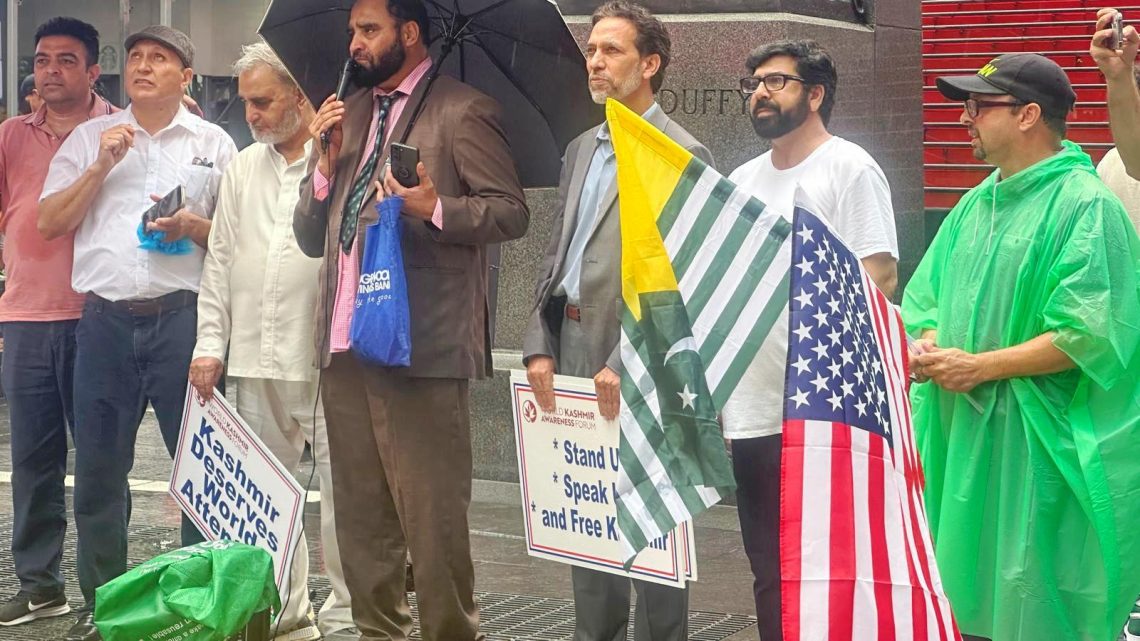
September 29, 2025Hundreds of Kashmiri Americans sent a clear and powerful message to the world during a protest at the United Nations headquarters in New York. While India’s Foreign Minister, Dr S. Jaishankar, was speaking at the General Assembly, the demonstrators gathered to remind the international community of the long-standing conflict in Kashmir. They argued that for nearly eighty years, the people of Kashmir have been living under a harsh military occupation and have been denied their basic right to choose their own future.
The Unfulfilled Promise of Self-Determination
The central issue of the protest was the failure of the United Nations to follow through on its own resolutions regarding Kashmir. The demonstrators insisted that the promise of a vote, known as a plebiscite, to let the Kashmiri people decide their future is not an old issue but a current failure of the global system. They argued that India’s stubborn refusal to allow this vote makes a mockery of international law.
- The Foundation of the Dispute: UN Resolutions:
- Protesters pointed out that the demand for a free and fair vote is a right guaranteed by several UN Security Council resolutions.
- Sardar Sawar Khan, a former advisor, noted that this solution was first suggested by both India and Pakistan, which makes India’s refusal to honor it a direct rejection of its own early promises.
- India’s Reversal of Its International Commitment:
- Dr Imtiaz Khan, a Kashmiri American scholar, explained that New Delhi had accepted the instruction for a UN-watched vote in the early years.
- He said that India later changed its position after realizing a free vote would likely not be in its favor, choosing continued occupation over the will of the people.
- A Test of the United Nations’ Credibility:
- Dr Ghulam Nabi Fai strongly stated that the UN, an organization created to help the oppressed, faces its biggest test in Kashmir.
- He argued that for decades, Kashmiri calls for justice have been met with total silence from the world body, weakening its moral standing and purpose.
A Territory Under Siege: The Human Rights Crisis
The demonstration provided a clear and detailed account of the human cost of the occupation. The slogans on the banners reflected the daily reality for millions of Kashmiris. From political prisoners suffering in jails to the constant fear created by a huge military presence, the protesters described a society where basic human rights have been systematically crushed.
- The Fate of Political Prisoners:
- A main demand was the immediate release of all political prisoners, including well-known leaders like Mohammad Yasin Malik, Shabbir Ahmed Shah, and others.
- Sardar Imtiaz Khan of the JKLF North America made an urgent appeal for Yasin Malik, saying he is facing a life and death situation in New Delhi’s Tihar Jail.
- Suppression of Disagreement and Press Freedom:
- Sardar Zarif Khan condemned the serious limits on free speech and expression throughout Jammu and Kashmir.
- Placards accused India of making press freedom a crime, and speakers called on world powers to stop the Indian government’s attacks on activists and journalists.
- No Punishment Under Harsh Laws:
- Raja Razzaq spoke against the harsh laws that give Indian military forces sweeping powers.
- He claimed these laws provide legal cover for soldiers to commit human rights abuses without any fear of punishment.
- The Devastating Human Toll:
- Sardar Taj Khan gave shocking numbers on the conflict, citing over 100,000 civilian deaths since the struggle began.
- He also reported that more than 10,000 people have been victims of forced disappearances, and thousands of women have suffered from sexual violence used as a tool of war.
The Modi Government’s Aggressive Kashmir Policy
A major focus of the protest was the sharp worsening of the situation under the current Indian government led by Prime Minister Narendra Modi. Speakers argued that his government has replaced older policies with an aggressive plan aimed at forcing Kashmir’s complete merger with India. This new approach is seen as a threat to the very existence of Kashmiri identity and culture.
- Erasing Self-Rule: The Cancellation of Special Status:
- Protesters condemned the 2019 decision to cancel Article 370 of the Indian constitution, which had given Kashmir a degree of self-rule.
- Choudhary Mohammad Ishaq stated that conditions have gotten much worse under Modi and that this move was an obvious attempt to seize complete control.
- Engineering Population Change:
- A common fear was what protesters called “demographic terrorism,” the belief that India is actively trying to change the population balance by encouraging Hindu settlement in the Muslim-majority region.
- This policy is seen as an effort to permanently weaken the Kashmiri demand for self-determination.
- A Project of Colonization:
- Dr Ghulam Nabi Mir described Kashmir as the world’s oldest foreign occupation.
- The protesters’ slogans about ending “Indian colonization” framed India’s actions as a project to take land from the native people.
A Looming Threat to Regional and Global Security
The demonstrators made it clear that Kashmir is not a distant issue but a dangerous flashpoint that could start a bigger war between two nuclear-armed countries. They urged the world to recognize the great danger of not taking action. The heavy military presence and unresolved issues have created an unstable environment that threatens all of South Asia.
- The Nuclear Flashpoint of South Asia:
- Rohail Dar warned that the Kashmir dispute has turned the area into the most dangerous nuclear hotspot on the planet.
- He reminded everyone that the conflict has already caused two major wars between India and Pakistan, and the next one could be nuclear.
- The Call for Global Action:
- Amna Habib, a social worker, argued that the United States has a responsibility to take a leading role in solving the conflict.
- Dr Amarjit Singh appealed to the international community to use its diplomatic and economic power to push India to fulfill its promises.
Conclusion
The protest outside the UN was a powerful and strong refusal by the Kashmiri people to be silenced or forgotten. The message was clear and firm: the struggle for justice and self-determination will continue. The demonstration served as a serious warning to the world that ignoring the Kashmir issue is the same as supporting oppression. The urgent calls from the streets of New York were a plea for the world to finally act before this long-running conflict turns into a major disaster.