Ladakh’s Betrayal: A People’s Fight Against a Plan to Change Their Homeland
September 27, 2025The Modi government’s carefully built story of “normalcy” in Indian illegally occupied Jammu and Kashmir has been completely destroyed on the cold, empty streets of Leh. For the fourth day in a row, a strict military curfew has made the town a prison for its own people. This is not a surprise event; it is the violent result of six years of growing anger, broken promises, and planned political betrayal by New Delhi. The killing of four unarmed civilian protesters by Indian forces has started a fire that shows the ugly truth of Indian rule: it is a rule like that of a foreign power, where calls for basic political rights are met with bullets, and where an entire people faces a threat to their survival, their land, and their identity.
A Region Under Military Lockdown
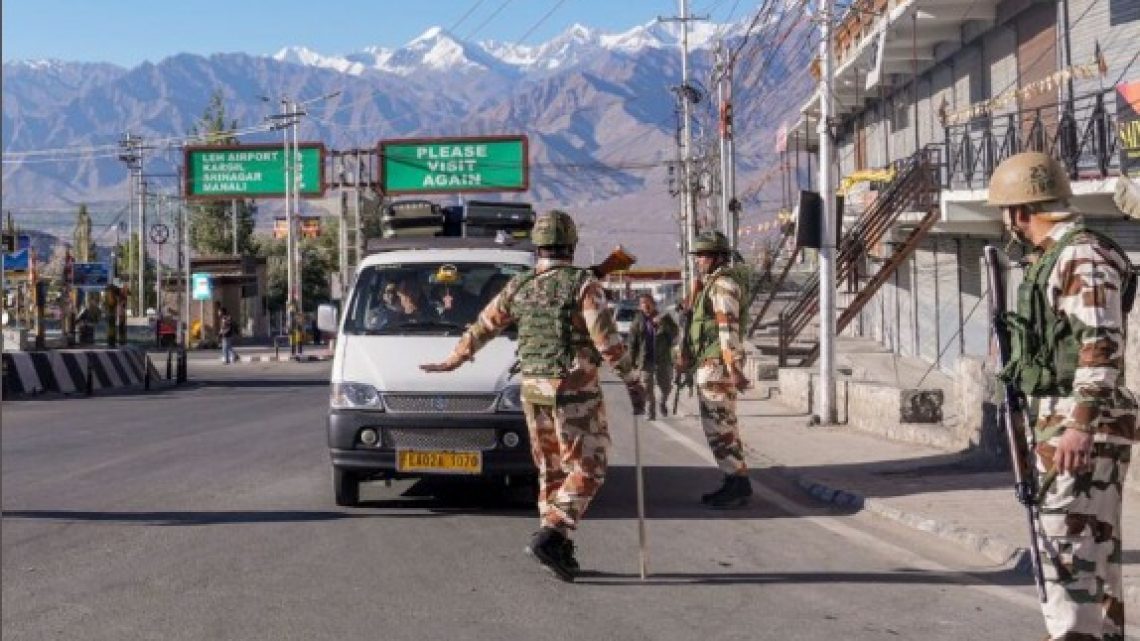
The current situation across the Ladakh region is a clear example of the Indian government’s tough method of crushing disagreement. Instead of political talks, the Modi government has used huge force, putting the entire population under a lockdown. This military action is not meant to keep the peace, but to scare the people into silence, making it clear that their political hopes do not matter to the rulers in New Delhi.
- The Government’s Heavy Hand:
- A strict curfew continues in Leh, and all government and private schools, colleges, and other educational places have been ordered to close.
- Indian army and paramilitary soldiers, wearing full riot gear, are patrolling the empty streets to stop any kind of public protest against the government.
- Crushing Disagreement with Mass Arrests:
- In a large-scale crackdown, Indian police have arrested over 50 people to break the leadership of the popular protest movement, which is led by the Leh Apex Body (LAB).
- Strict orders banning public gatherings of five or more people are also in place in other big towns, like the Kargil district, to stop the protests from growing.
- Punishing the Entire Population:
- This military lockdown has created a crisis for the people, with families in many areas saying they are running out of essential supplies.
- The shortage of basic items like food, milk, and vegetables is being used as a weapon to punish the whole population for demanding their rights.
The History of Betrayal and Protests
The explosion of anger seen on Leh’s streets is the expected result of a long and painful history of lies from the Indian government. The people of Ladakh, in both Leh and Kargil, feel very betrayed by the promises made to them after the illegal removal of Articles 370 and 35A in 2019. They have learned the hard way that their patience was seen as weakness, and their hopes for political power have been crushed by an arrogant central government.
- The Broken Promise of Self Rule:
- The current wave of protests, which started to grow in 2020, began with the creation of the Union Territory (UT) of Ladakh, which was formed without a local assembly.
- This political trick effectively took away the local people’s political power, making sure they would no longer be in charge of their own land or future.
- A People Who Have Lost Patience:
- Political leaders have said that the protests prove that the people are finally fed up with the Modi government’s continuous betrayals and broken promises.
- The main demands of the people are clear and cannot be negotiated: they want full Statehood for Ladakh and for the region to be included in the Sixth Schedule of the constitution to protect their identity and land.
The Threat of a Changing Population
At the center of the Ladakh protests is a deep and real fear for the survival of the region’s special culture and identity. The current Union Territory system, forced upon them by New Delhi, has removed the legal protections that once protected the area from outsiders. The people of Ladakh now feel they are standing at the edge of a cliff, facing a future where they could become a minority in their own homeland.
- The Fear of Outsiders Moving In:
- Local people and experts are very worried that the current system will allow large numbers of people from other parts of India to come and settle in the region for good.
- They rightly fear that this will cause a big change in the local population, threaten their cultural identity, and lead to a terrible loss of land and job opportunities for the local people.
- A Planned Government Policy to Change Who Lives There:
- This threat does not seem to be an accidental result but a planned policy. Experts point to a long-held belief in powerful strategic and military groups in India that are influenced by the RSS.
- This belief is that security on the borders with China and Pakistan can only be improved by settling more outsiders in Ladakh. This shows that changing who lives there is a planned goal of the Indian government.
A Colony Ruled by Outsiders
The feeling of being powerless is made worse by the daily reality of being ruled by a government that is completely out of touch with the local people. The current government system in Ladakh works like a system used by rulers in a colony, where officials from mainland India rule over the local people, and the person with the final power is a political appointee who is loyal to the BJP, not to the people of Ladakh.
- A Government Run by Non Locals:
- The people of Ladakh feel they have no power because most of the senior government officials who run the region are from mainland India and do not understand the local culture or their problems.
- A Political Agent in Command:
- The Lieutenant Governor, who holds the final power in the region, is seen as a political agent for the central government.
- He is a loyal follower of the BJP party from the Jammu region, which makes local people feel even more strongly that they are being ruled by outsiders who are only there to serve New Delhi’s political goals.
Conclusion
The violent crackdown in Leh has completely destroyed the Modi government’s false story of peace and progress in the region. The killings, the curfew, and the mass arrests are not signs of normalcy; they are the desperate moves of a ruling power that has lost all right to govern. The people of Ladakh have been betrayed, their political rights have been stolen, and they now face a planned, government-backed plan to change their population and erase their identity. Their struggle is more than just a protest for political demands; it is a fight for their cultural survival against a cruel government that sees their land as a strategic prize and its people as pieces that can be thrown away.