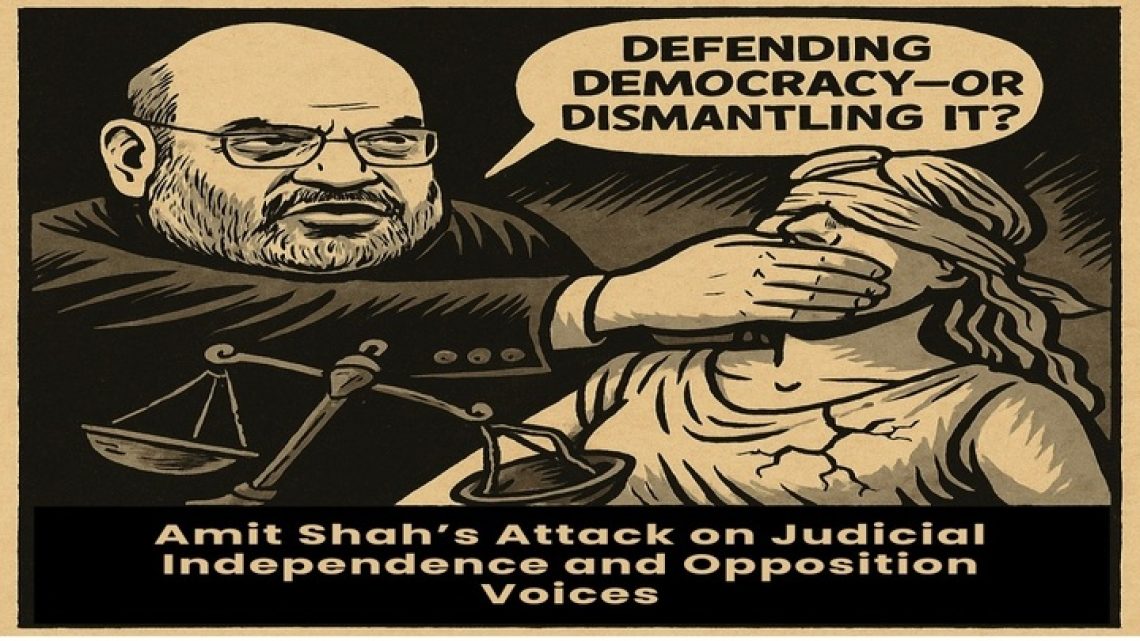
Amit Shah’s Attack on Judicial Independence and Opposition Voices
August 27, 2025Union Home Minister Amit Shah’s recent comments targeting Justice B. Sudershan Reddy, the Opposition’s candidate for Vice-President, are deeply concerning. Shah’s accusation that Reddy supported Naxalism due to his judgment on the Salwa Judum militia exposes a dangerous trend in India’s political landscape. This attack on judicial independence is part of the BJP’s broader strategy to criminalize dissent and silence opposition, which threatens the very core of India’s democracy.
The Salwa Judum Verdict: Defending Rights
In 2011, Justice Reddy, with Justice S.S. Nijjar, ruled against the Salwa Judum militia, a government-backed force that violated the rights of tribal communities. The militia recruited tribal youth to combat Maoist insurgents, causing harm to vulnerable populations. The ruling upheld constitutional values by protecting marginalized groups from state-led violence. Instead of praising this protection of human rights, the BJP is attempting to discredit it.
Amit Shah’s False Accusation
Amit Shah’s accusation that Justice Reddy supported Naxalism is a direct distortion of the truth. Shah’s attack seeks to discredit a judgment that protected the rights of marginalized communities by falsely portraying it as supporting insurgents. This attack aims to delegitimize legal decisions that challenge the government’s policies, creating a narrative that opposes constitutional morality.
Political Interference in the Judiciary
Shah’s comments reflect a broader trend of political interference in the judiciary. The BJP has long been accused of using legal decisions for political advantage. Targeting Justice Reddy for a judgment that went against government interests shows how the ruling party seeks to weaken judicial independence and manipulate the legal system for political gain.
Defending Human Rights and Constitutional Morality
Justice Reddy’s ruling on the Salwa Judum was a defense of constitutional morality. The decision protected the fundamental rights of tribal communities that were at risk of violence. Rather than supporting this judgment, which was based on protecting vulnerable groups, the BJP has chosen to attack it, undermining the protection of human rights.
Criminalizing Dissent: A BJP Strategy
The BJP’s strategy of criminalizing dissent goes beyond the judiciary. By labeling critics as “anti-national,” the government seeks to silence anyone who opposes its policies. The attack on Justice Reddy shows how the BJP uses false accusations to eliminate opposition voices, including those from the judiciary, turning lawful actions into politically motivated attacks.
Legal Experts Condemn the Attack
Leading legal figures have strongly condemned Amit Shah’s remarks. Judges like Justice J. Chelameshwar, Justice Madan B. Lokur, and senior advocate Sanjay Hegde have criticized the attack on Justice Reddy, calling it a misinterpretation that undermines judicial independence. Their condemnation highlights the danger of politicizing legal decisions and the importance of defending the dignity of the judiciary.
Minorities and Vulnerable Groups Under Attack
The attack on Justice Reddy raises concerns for other vulnerable groups in India. If a respected judge can be vilified for defending the rights of marginalized communities, it sets a dangerous precedent for others. Minorities, indigenous groups, and activists are increasingly at risk of being labeled as enemies of the state, simply for standing up for their rights.
The BJP’s Use of Fear to Control
The BJP has increasingly used fear as a tool to control opposition. By equating judicial decisions with acts of subversion, the ruling party creates an atmosphere where dissent is criminalized. This narrative erodes trust in the legal system, polarizes society, and undermines the democratic values that India’s political system has long upheld.
Repression of Political Opposition
The attack on Justice Reddy is part of a broader effort to suppress political opposition. The BJP’s attempt to discredit opposition leaders and critics as “traitors” and “insurgents” further restricts space for political debate. This growing repression threatens India’s democracy by stifling alternative voices and pushing dissent to the margins.
Judicial Independence: A Key to Democracy
Judicial independence is essential for any functioning democracy. Without it, the rule of law becomes vulnerable to political manipulation. The attack on Justice Reddy is a direct assault on this principle, showing that the BJP is willing to undermine the judiciary to further its political interests. Without judicial independence, the very foundations of democracy begin to erode.
Protecting Minority Rights and Dissent
Protecting the rights of minorities and ensuring that dissent is not criminalized are essential components of a democratic society. The BJP’s attack on Justice Reddy, and its broader efforts to stifle opposition, threaten these fundamental principles. If dissent is silenced, and rights are ignored, India risks moving away from its democratic ideals.
The Rule of Law Under Threat
The BJP’s actions show a disregard for the rule of law. By attacking judicial decisions that challenge its policies, the government is turning the law into a tool for political control. The law must protect everyone, regardless of their political views. But the BJP’s use of the law to suppress dissent risks undermining the justice system.
Conclusion: Defending Democracy from Authoritarianism
Amit Shah’s attack on Justice Reddy is a dangerous sign of the BJP’s growing authoritarianism. The attack on judicial independence, the criminalization of dissent, and the suppression of political opposition are weakening the democratic structures of India. To protect India’s democracy, it is essential to defend judicial independence, safeguard the rights of minorities, and ensure political opposition is respected. Without these fundamental pillars, India risks sliding into authoritarianism, where fear replaces justice and democracy.