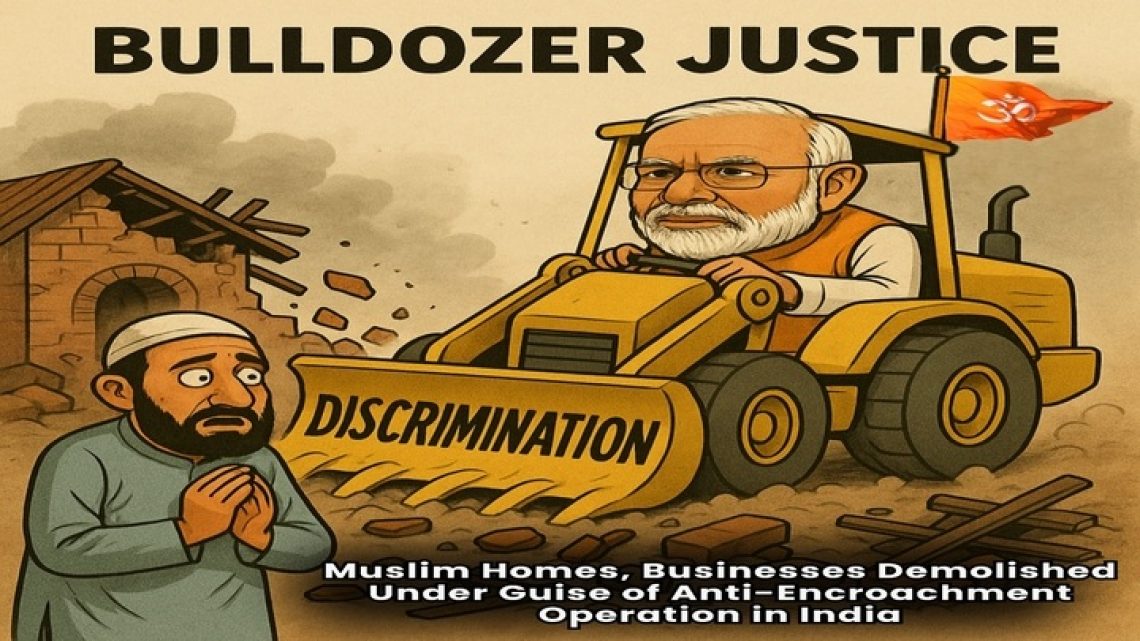
Muslim Homes, Businesses Demolished Under Guise of Anti-Encroachment Operation in India
August 27, 2025In India, the so-called “bulldozer justice” is being used to demolish homes, shops, and properties, primarily belonging to Muslims, under the cover of anti-encroachment operations. Despite the Indian Supreme Court declaring these demolitions unconstitutional, they continue, raising concerns over religious discrimination and human rights violations. Critics argue that these actions are less about clearing illegal structures and more about persecuting a specific community.
The Bulldozer Campaign and Its Impact
Across several Indian states, bulldozers have been used to demolish properties, especially in Muslim-majority areas. The government claims these actions aim to remove illegal encroachments, but the bulldozing has disproportionately affected Muslims, despite the Supreme Court ruling such demolitions illegal without proof of wrongdoing. This selective targeting is seen by many as a political tool to intimidate Muslims and further marginalize them.
Supreme Court Rulings and Constitutional Violations
India’s Constitution guarantees equality and protection from discrimination, yet the bulldozer demolitions violate these rights. The Indian Supreme Court has repeatedly ruled that demolitions should not happen before charges are proven, but local governments have ignored these rulings. These actions not only defy the law but also highlight the selective application of legal protections, particularly when religious minorities are involved.
The Political Motivation Behind Demolitions
The bulldozer demolitions, particularly under the BJP government, are seen as politically motivated. Critics argue that these demolitions are part of a strategy to target Muslims while strengthening the BJP’s Hindu-majority voter base. Rather than enforcing urban laws, the government uses demolitions to send a message of control, reinforcing religious divisions and alienating Muslims from mainstream society.
The Effect on Muslim Communities
The bulldozer justice campaigns have left many Muslim families homeless and their businesses destroyed. These families are left without compensation or legal recourse, facing economic ruin. The constant fear of demolition has created widespread insecurity within Muslim communities, contributing to a growing sense of alienation and persecution. For Muslims, these demolitions symbolize not only physical destruction but also the marginalization they face in Indian society.
Legal Challenges and the Court’s Role
The Indian Supreme Court has ruled that demolitions should not occur without due process, but these rulings have had little impact on halting the bulldozer campaigns. Local governments, especially in BJP-controlled areas, continue to defy the court’s orders. This lack of enforcement undermines the credibility of the judicial system, allowing unlawful demolitions to persist without accountability.
International Response and Human Rights Violations
The international community has criticized India’s bulldozer justice campaigns as human rights violations. Human rights organizations have condemned the demolitions, calling them a form of collective punishment against Muslims. Despite international pressure, the Indian government has largely ignored these concerns, continuing to justify the demolitions as part of urban development and law enforcement.
Economic and Social Consequences for Muslims
The bulldozer demolitions have had severe economic consequences for Muslims. Many families have lost their homes and businesses, and without compensation, they face immense challenges in rebuilding their lives. The destruction of Muslim-owned businesses has disrupted local economies and led to widespread unemployment, further isolating these communities.
Deepening Religious Divisions in India
The bulldozer campaigns have deepened religious divisions in India, with Muslims increasingly feeling targeted by state actions. The selective targeting of Muslim properties has created an atmosphere of fear and division, pushing Muslims further to the margins of society. These demolitions are seen as part of a broader pattern of religious exclusion under the current government, contributing to social and political polarization.
Global Criticism and Lack of Accountability
The bulldozer campaigns have drawn strong international condemnation. Human rights organizations and global media outlets have called for India to halt these actions and protect the rights of religious minorities. However, the Indian government has dismissed these criticisms, focusing instead on its political agenda. This lack of accountability only strengthens the perception that the demolitions are a tool of religious persecution, rather than an honest attempt to enforce the law.
The Path Forward: Legal and Political Accountability
The continued bulldozer demolitions highlight the need for greater accountability in both the legal and political spheres. The Indian judiciary must enforce its rulings and ensure that the rights of Muslims and other minorities are protected. Additionally, the government must stop using bulldozers as a tool of oppression and instead focus on creating an inclusive society where the rights of all citizens are respected, regardless of their religion.
Conclusion: Justice and Equality for All
The bulldozer justice campaigns in India represent a grave violation of constitutional rights and human dignity. The targeting of Muslim properties under the pretext of anti-encroachment drives undermines the rule of law and fuels religious discrimination. It is essential for the Indian government to respect the Supreme Court’s rulings and protect the rights of all its citizens, particularly religious minorities. Until then, the bulldozer campaigns will continue to divide society and perpetuate injustice.