Legislature Politics in IIOJK: The “Nomination Row” Sparks a Democracy Debate
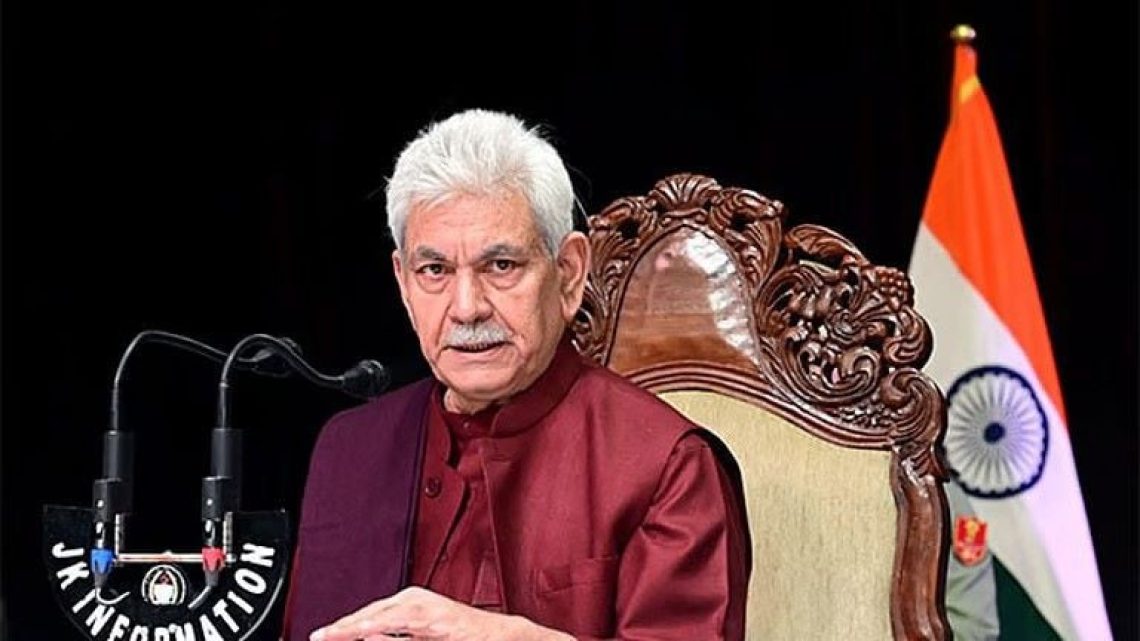
August 24, 2025A fresh legal and political storm has erupted in Indian Illegally Occupied Jammu & Kashmir (IIOJK). The MHA (Ministry of Home Affairs) recently submitted a pivotal affidavit in the IIOJK High Court asserting that the Lieutenant Governor (LG) alone holds the authority to nominate five members to the Legislative Assembly—without consulting the elected government. This bold claim has ignited fierce debate about democratic integrity, regional autonomy, and constitutional norms.
The Roots of Dispute: Legal Provisions vs Democratic Mandate
Congress leader Ravinder Kumar Sharma filed a petition challenging the constitutionality of Sections 15, 15A, and 15B of the Jammu & Kashmir Reorganisation Act, 2019. These provisions authorize the LG to nominate five members—two women, two Kashmiri migrants (one being a woman), and one person displaced from Pakistan-Occupied Jammu & Kashmir (PoJK)—into the Legislative Assembly.
Sharma, represented by Dr. Abhishek Manu Singhvi, argues that such unaffiliated appointments skew electoral equations and undermine the principle that the Executive must act on the “aid and advice” of the elected council of ministers—potentially altering the democratic mandate itself.
MHA’s Rebuttal: A Case for Inclusivity and Statutory Autonomy
The MHA, via its affidavit, maintains:
- The nomination power is a statutory discretion, not an executive act requiring consultation with the elected government—mirroring the legislative model in Delhi and Puducherry.
- The amended Sections 15A and 15B, introduced in 2023, are aimed at improving representation for marginalized groups such as women, Kashmiri migrants, and PoJK displaced persons—groups often absent in the electoral landscape.
- The LG’s powers are constitutionally supported under Article 239A, as J&K remains a Union Territory with unique governance structures. Therefore, the LG can act independently of the council of ministers where specified by law.
Political Backlash: Is Democracy Being Undermined?
Regional political leaders have strongly criticized the move:
- Mehbooba Mufti (PDP) condemned it as a “blatant subversion of democratic principles,” warning that the practice of central nomination undermines the people’s mandate.
- Tanvir Sadiq (NC spokesperson) called it contempt for democratic values, cautioning that allowing handpicked legislators sets a troubling precedent.
- M.Y. Tarigami (CPI-M) labelled the move an overt assault on representative governance.
High Stakes: Assembly Strength and Parliamentary Impact
Currently, the IIOJK Assembly has 90 elected members. The addition of five LG-nominated MLAs increases the total to 95, raising the majority threshold from 45 to 48—an election-altering shift.
In national politics, IIOJK elects four Rajya Sabha members. The current NC–Congress combination holds a majority, but the nominated MLAs could enable the BJP to secure an additional seat, altering national balance.Political leaders fear this mechanism could be used to influence legislative dominance and skew electoral outcomes under the guise of representation.
Legal Timeline: Proceedings & Constitutional Questions
Sharma’s plea was filed in 2025, prompting an MHA response that frames the nominations as budget-neutral to the formation of a government. The High Court hearing will resume in September 2025 to determine the constitutional validity of the nomination power.
Central to the court’s decision is whether these provisions breach the basic structure of the Constitution, especially democratic representation and separation of powers.
Broader Implications: Centralization & Union Territory Governance
This nomination controversy is emblematic of broader trends after the abrogation of Article 370: centralizing governance, delimitation changes, and incremental erosion of autonomy. Critics argue these moves gradually convert regional politics into a system controlled from Delhi.
Comparisons to Puducherry’s legislative setup raise concerns about centralized influence in Union Territories—but questions persist whether J&K, as a former state, should follow the same framework.
Why It Matters
- Democratic Integrity: Can an unelected LG legitimately shape legislative outcomes?
- Representation vs. Manipulation: Are these nominations genuine representation, or veiled political maneuvering?
- Future Precedent: Will this model be extended to other Union Territories with legislative assemblies?
- Judicial Oversight: How will India’s constitutional courts balance statutory provisions with democratic tenets?
Conclusion
The “Nomination Row” in IIOJK is more than a legal squabble—it’s a test of democratic principles, constitutional governance, and the balance between representation and power. As the High Court decides, the outcome will influence the future of governance in Jammu & Kashmir and reinforce—or challenge—the boundaries of Union Territory administration.