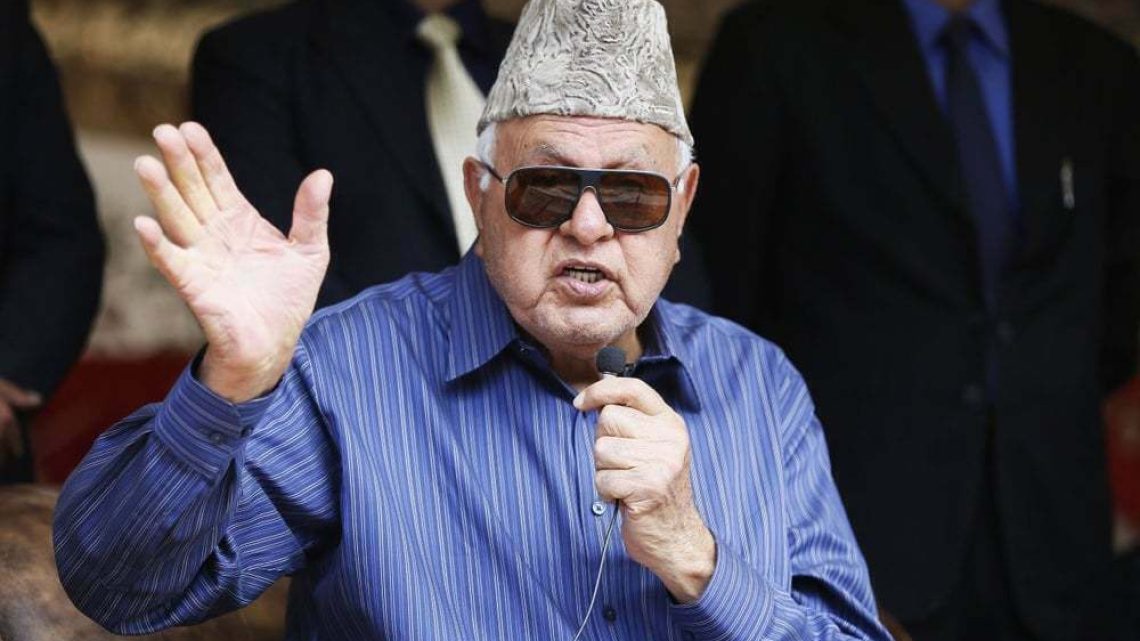
Farooq Abdullah Exposes India’s False Peace Claim in IIOJK: Says No End to Militancy Without Dialogue with Pakistan
August 5, 2025While the Indian government repeats its claims that militancy has ended in Indian Illegally Occupied Jammu and Kashmir (IIOJK), veteran political leader and National Conference President Farooq Abdullah has strongly rejected these claims. He made it clear that peace in the region is not possible without a real improvement in ties between Pakistan and India.
According to media reports, he made these remarks during his visit to Shopian, while speaking to journalists, and later in Srinagar during a meeting with party delegations. When asked about India’s statements that militancy in IIOJK has ended, Abdullah responded bluntly, “Militancy will not end here till our relations with our neighbour do not become better,” he said, highlighting the deep-rooted political nature of the conflict.
A Question That Shakes the Indian Narrative
In response to a question about an ongoing encounter in Kulgam, Abdullah openly questioned the government’s claims, saying, “How can you say that militancy has ended when the encounter is going on?” His statement directly challenges New Delhi’s consistent narrative of “normalcy” in the region.
These words have exposed the disconnect between ground realities and the Indian government’s repeated statements. If there is peace, why do such operations continue? If there is no militancy, why are armed encounters still part of daily life?
August 5 Actions Still Rejected by IIOJK’s People
Abdullah also used the occasion to reiterate his party’s rejection of the Indian government’s move on August 5, 2019, when the special constitutional status of the region was unilaterally and unlawfully removed by revoking Articles 370 and 35-A.
He made it clear that the people of IIOJK and his party do not accept this decision, nor do they consider it legitimate. “The events of August 5, 2019, caused deep hurt and disappointment among the people of Jammu & Kashmir. As a party, we remain committed to pursuing the restoration of our constitutional and democratic rights through peaceful, democratic, and constitutional means. Our resolve is rooted in the aspirations and sentiments of the people,” he said.
National Conference: Peaceful but Firm
Abdullah reaffirmed that his party would continue its peaceful and democratic struggle for the restoration of IIOJK’s constitutional and political rights. He emphasized that despite being pushed against the wall, the National Conference believes in dialogue, democracy, and peaceful politics not confrontation or violence.
This commitment stands in sharp contrast to the Indian government’s approach, which has focused on silencing dissent rather than listening to legitimate demands.
Reality Check for New Delhi
The BJP-led Indian government has long claimed that its decisions have brought development and peace to IIOJK. However, continued violence, political arrests, media gagging, and human rights violations show otherwise.
Abdullah’s words offer a reality check to those who believe that conflict can be ended with military power alone. His message is clear: lasting peace cannot come through control, it must come through consensus.
Ignoring Pakistan Is Not a Strategy, It’s a Mistake
One of the key takeaways from Abdullah’s remarks is his firm stance on Pakistan’s role. He did not shy away from saying what needs to be said: India cannot solve the issue of IIOJK without engaging Pakistan.
For years, New Delhi has avoided meaningful talks, and instead relied on isolation and force. But even leaders from within IIOJK are now pointing out the failure of this approach. As long as relations with Pakistan remain tense, the region will not see lasting calm.
The People Have Not Accepted New Delhi’s Decision
Despite India’s continuous efforts to change the narrative, the people of IIOJK have not accepted the August 5 move. The silence that India promotes as peace is actually the result of fear, force, and information blackout.
Public expression is restricted. Political leaders are detained. Media outlets are controlled. Yet, the emotions, memories, and demands of the people remain unchanged.
Pakistan’s Voice Echoes Through IIOJK
Farooq Abdullah’s words reflect what Pakistan has consistently said at every international forum: that IIOJK is not an internal issue of India, but a long-standing international dispute that must be resolved according to the will of the people.
Pakistan has always maintained that peace is possible only when the Kashmiri people are allowed to decide their future. Farooq Abdullah, speaking from within the occupied region, has reaffirmed that truth.
The Global Community Cannot Stay Silent
India’s claims are not only false rather they are dangerous. When a government calls fear “peace” and silence “progress”, it opens the door to long-term instability.
The international community must pay attention to voices like Farooq Abdullah’s. These are not random statements rather they are warnings from people who live the consequences of Indian policy every day.
Conclusion: Dialogue Is the Only Path Forward
Farooq Abdullah’s recent statements carry a weight that no amount of propaganda can hide. They are clear, honest, and based on lived reality. India must choose between continuing its policy of denial or facing the truth and moving toward genuine resolution.
Militancy is not the cause; it is the result. The cause is injustice, broken promises, and silenced voices.
Only meaningful dialogue, involving all stakeholders, including Pakistan can bring the peace that India claims to have achieved. Until then, claims will remain claims, and the people of IIOJK will continue their democratic and constitutional struggle for justice.