BJP’s False Promises Crushed as Mehbooba and Farooq Reveal Reality of IIOJK
August 4, 2025The dark cloud over Indian Illegally Occupied Jammu and Kashmir (IIOJK) continues to thicken as senior leaders Mehbooba Mufti and Farooq Abdullah expose the harsh reality of fear, suppression, and broken promises under the BJP-led Indian government. Their courageous statements dismantle India’s scripted tale of development and reveal a painful truth: August 5, 2019, was not a day of reform; it was a moment of occupation.
A Volcano of Rage Under Silenced Voices
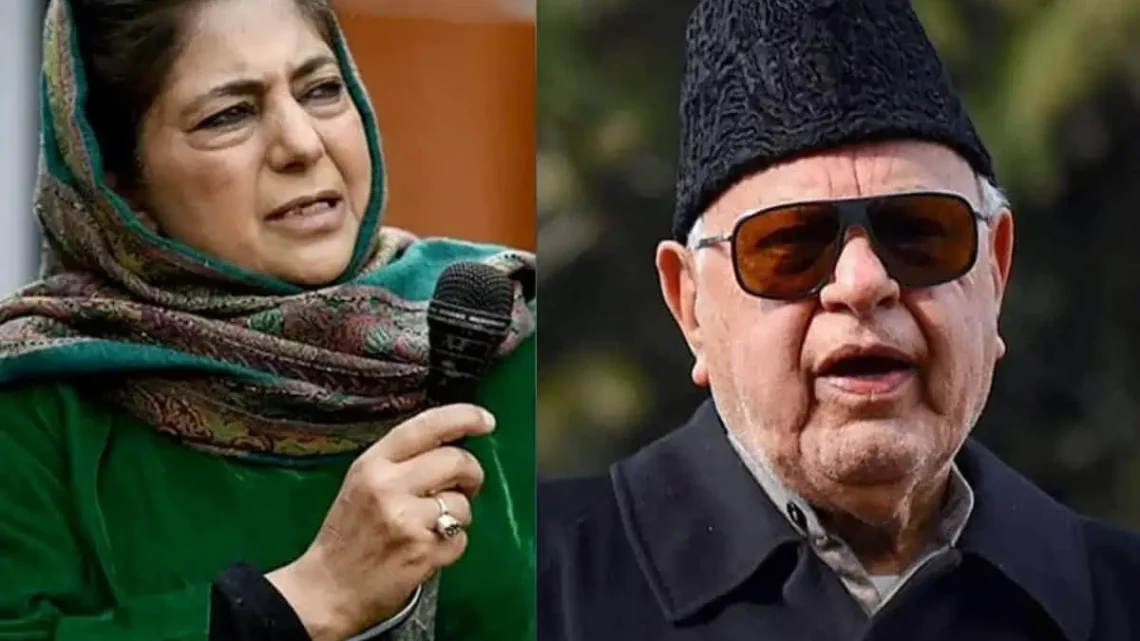
As reported by the Kashmir Media Service, Peoples Democratic Party (PDP) President Mehbooba Mufti, during a press briefing in Jammu, emphasised the urgent need for initiating dialogue with the people of Indian Illegally Occupied Jammu and Kashmir (IIOJK) prior to any engagement with Pakistan. She critically highlighted that the rigid and authoritarian approach adopted by the BJP-led government has not fostered peace but has instead suppressed public expression.
Mufti cautioned that beneath this enforced silence, widespread discontent is steadily intensifying, and a “volcano is building.” It must be addressed otherwise, it will lead to serious political and social consequences.
“The developments of August 5, 2019 when New Delhi revoked special status of Kashmir under Article 370 and bifurcated the territory into two Union Territories destroyed J&K on the pretext of improving the situation and restoring peace. People were promised rivers of milk and honey,” Mufti said.
Her words shook the silence: any dialogue must begin with the people of IIOJK before any engagement with Pakistan is even considered. This silence is not peace—rather it is forced quiet. The curfews, mass detentions, and constant surveillance have turned IIOJK into a space where fear speaks louder than freedom. The BJP regime has not created harmony; it has manufactured helplessness.
August 5: Breaking Kashmir’s Promise
Mufti recalled that India had claimed that the revocation of Article 370 and 35-A would bring stability and progress. “People were promised rivers of milk and honey.” What remains now is only bitterness and betrayal.
The territory was torn apart, converted into Union Territories, and stripped of its constitutional identity—all in the name of development. But what unfolded was collective punishment disguised as policy. Instead of peace, India handed out pain. Instead of justice, it offered propaganda.
Tyranny Hid in Legal Language
Mufti sharply criticised the BJP’s use of draconian laws such as the Public Safety Act and Unlawful Activities (Prevention) Act. She said that this rigid policy has failed miserably. These laws have been used to imprison thousands without trial, muzzle the press, and stifle dissent.
When laws become weapons and courts become tools of repression, democracy stands defeated. In IIOJK, law no longer protects—it punishes. The BJP has criminalised protest and has turned basic rights into punishable offences.
Broken Roadmap, Broken Trust
Mufti reminded New Delhi of the 2015 ‘Agenda of Alliance,’ which had once promised local empowerment, revocation of harsh laws, and a return of local resources. That promise now lies in ruins, replaced by authoritarian control.
The abandonment of the alliance is not just a political betrayal; it is a signal that Kashmiris were never meant to be partners in their own future. It shows a deep-rooted plan to centralise control and crush every voice of autonomy.
Abdullah’s Faith in Justice
Former Chief Minister Farooq Abdullah maintained that the people of IIOJK would eventually reclaim their rights.
“We believe our rights will be restored. We are not like them; we trust in the Almighty,” Abdullah said.
His words carried not just faith, but defiance against occupation. Abdullah’s trust in justice is not blind; it is built on the strength of a people who have endured. His optimism is a political message: dignity cannot be revoked by decree, and identity cannot be erased by force.
Indian Decline Under Rhetoric
Abdullah also pointed to India’s declining economic strength. He warned that the government’s empty slogans were dragging the country toward crisis.
“The groundwork for India’s economic destruction is being laid while industries shift abroad.”
While claiming victories at home, the BJP is losing ground abroad. Its economic promises collapse under the weight of global isolation, domestic job losses, and rising inequality. In IIOJK and in the mainland, the cost of hyper-nationalism is being paid by the common people.
Democracy Disabled Overnight
Both leaders exposed how India’s democracy was suspended in IIOJK on August 5. Assembly elections remain on hold, political opponents are silenced, and media houses are forced to conform.
The revocation was never about integration; it was about domination. Elections have turned into formalities, and leadership has been replaced by loyal administrators. What exists in IIOJK today is not governance; it is control without consent.
Silence from the World
While New Delhi tramples UN resolutions and human rights, the international community watches in silence. This indifference has become complicity. Human rights watchdogs issue statements but stop short of action.
This silence allows India to act without consequences. Global forums must ask themselves: what is the value of resolutions if violations are ignored? What is the point of peacekeeping when oppression is rewarded with silence?
Never Surrendered
Despite decades of occupation and systematic violence, the people of IIOJK have not surrendered. Their resolve is unshaken, their voice is steady, and their cause remains rooted in international law and moral truth.
Farooq Abdullah’s words echo the collective resolve: Kashmiris resist not with force, but with endurance. They remain committed to their rights, their heritage, and their future. Every unlawful arrest only strengthens their resolve. Every draconian law fuels their determination.
Conclusion: A Land Occupied by Betrayal
Indian Illegally Occupied Jammu and Kashmir today stands as a symbol of betrayal. The abrogation of Articles 370 and 35-A did not bring peace; it introduced punishment. It did not unite—rather it divided.
If the international community fails to listen, August 5 will forever remain a stain on democratic ideals. Kashmiris have not forgotten. They have not surrendered. And until justice returns, that day will remain a warning: a reminder of how silence can turn into complicity, and how a people betrayed can become a nation awakened.