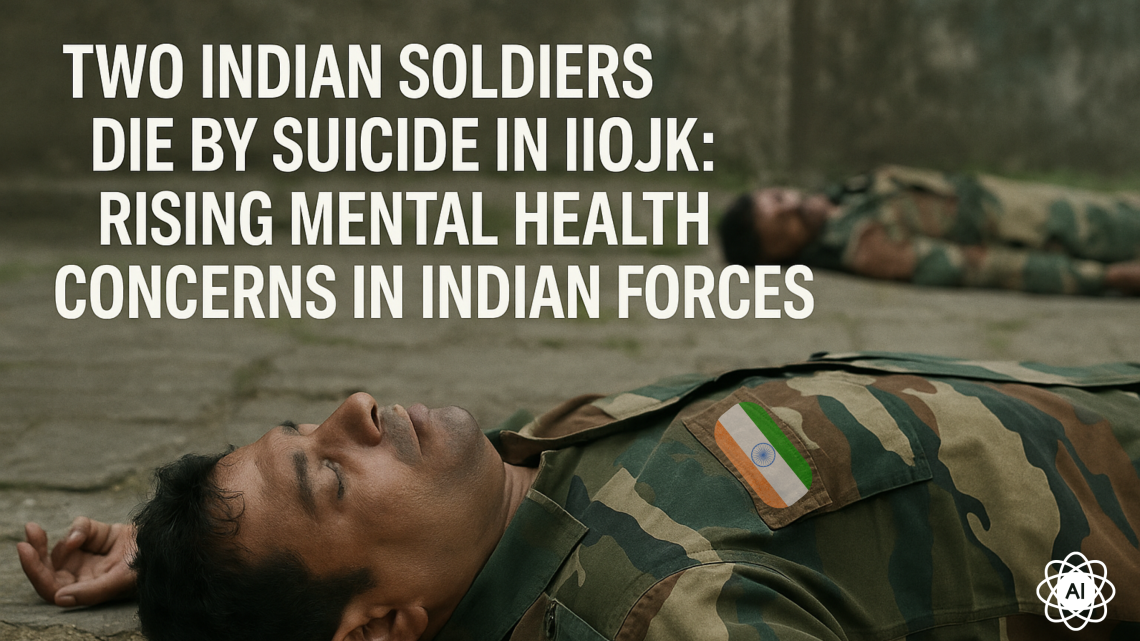
Two Indian Soldiers Die by Suicide in IIOJK: Rising Mental Health Concerns in Indian Forces
July 7, 2025Two tragic suicides within Indian armed forces stationed in IIOJK highlight growing mental health concerns among troops deployed in high-stress conflict zones.
In two separate incidents reported from Indian Illegally Occupied Jammu and Kashmir (IIOJK), two Indian soldiers have died by suicide, raising serious questions about the psychological toll of prolonged deployment in the region.
The first incident took place at a military camp in Solki village, located approximately 40 km from Rajouri town. A soldier attached to the 54 Rashtriya Rifles reportedly shot himself with his service rifle inside the company headquarters. The army has launched an investigation into the cause of the suicide, though initial reports suggest no external threat or attack was involved.
In a separate and equally disturbing incident, Mridul Dass, a constable of the Border Security Force (BSF), took his own life at a forward post in the Ramgarh area of Samba district. He reportedly used his service weapon to end his life. The authorities are probing the circumstances leading up to the tragedy.
These incidents are not isolated. Over the past few years, there has been a growing pattern of suicides and fratricidal incidents among Indian armed personnel in Kashmir. Experts and former army officers have repeatedly pointed out that mental health issues, lack of leave, family separation, and constant stress in conflict zones contribute heavily to such outcomes.
While official responses often cite “personal reasons” for such deaths, analysts argue that deeper systemic issues—including moral fatigue, unclear mission goals, and prolonged exposure to anti-insurgency operations in hostile environments—are playing a role in the rising suicide numbers among soldiers deployed in IIOJK.
These tragic deaths underscore the urgent need for mental health reforms within Indian paramilitary and armed forces. Counseling access, reduced deployment time, and improved morale measures are frequently recommended but rarely implemented on the ground.