Ganderbal Residents Block Highway in Protest as Water Shortages Grip Kashmir
July 2, 2025When taps run dry and authorities stay silent, desperate communities resort to the streets—Ganderbal locals halted traffic for an hour, demanding relief from an escalating water crisis under the summer sun.
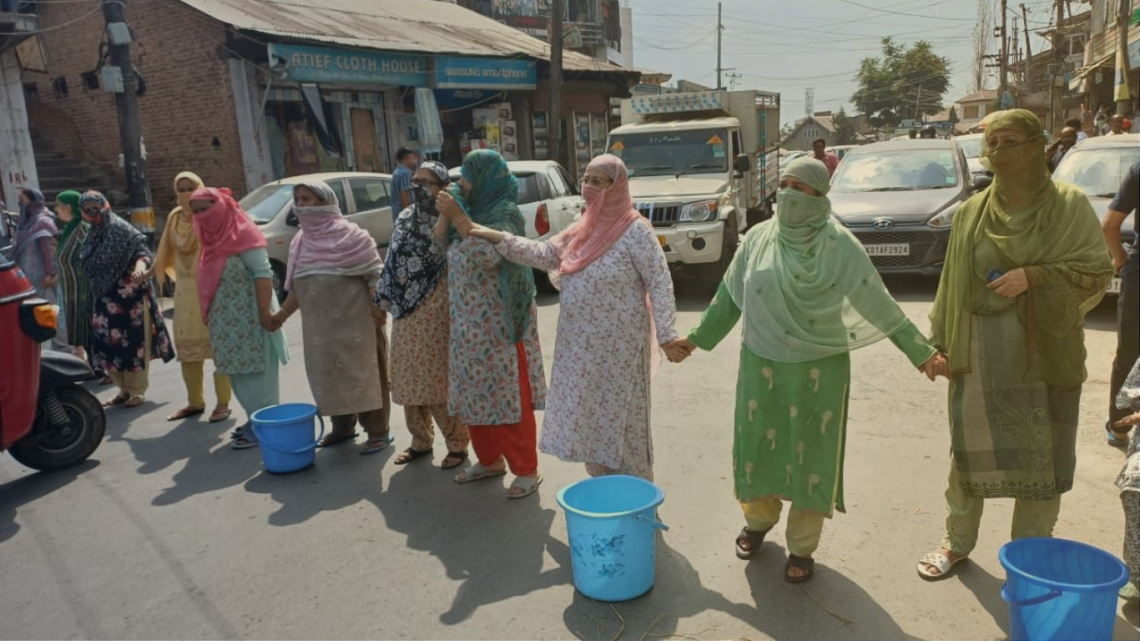
Residents of Ganderbal district in Indian illegally occupied Jammu and Kashmir staged a dramatic demonstration this week to highlight an acute shortage of drinking water that has plagued their homes for several weeks.
The protestors, including men and women of all ages, gathered on the Srinagar–Leh highway. They sat down across the road, effectively stopping traffic for nearly an hour while shouting slogans and holding placards demanding immediate action.
Locals say the shortage has reached unbearable levels in the current heat wave. “We haven’t had reliable water supply for weeks,” one demonstrator complained. “Children go thirsty, and families struggle to cook and clean. This is a basic necessity.”
A police contingent soon arrived to negotiate with the protest leaders. After tense discussions, officers assured the crowd that their grievances would be conveyed to higher officials. The demonstrators then dispersed peacefully, though many warned they would return if conditions didn’t improve.
Meanwhile, in Srinagar city and its surrounding neighborhoods, residents have also experienced significant interruptions in piped water service. Officials attribute the disruption to extensive repair work on the Sindh Power Canal (PDC), a critical artery that feeds the city’s water treatment plants.
According to administration sources, the canal maintenance is essential to prevent more severe breakdowns later in the monsoon season. However, there has been little public communication about timelines or contingency plans, leaving households in the dark—literally.
“Shutting off supply without warning is unacceptable,” said a Srinagar schoolteacher. “We’ve been told crews are working on the canal, but we don’t know when we’ll have water again. People are buying water at inflated prices.”
Local media reports indicate that tanker services have sprung up across both Ganderbal and Srinagar, charging anywhere from ₹50 to ₹100 for a single 1,000‑litre delivery. For low‑income families, these rates are barely affordable, prompting urgent calls for subsidized water or emergency drilling of new borewells.
Community leaders in Ganderbal have urged the district administration to deploy water tankers free of charge, prioritize stalled pipeline projects, and speed up PDC repairs. They warn that without swift intervention, public health risks—such as waterborne diseases—could surge.
“This isn’t just inconvenience; it’s a health emergency waiting to happen,” said a local veterinarian. “Contaminated or scarce water can lead to outbreaks of diarrhoea, cholera, and other illnesses.”
Political representatives from the region have pledged to raise the issue in the Jammu and Kashmir Legislative Assembly. They argue that the current crisis underscores long‑standing neglect of basic infrastructure in IIOJK, exacerbated by bureaucratic delays and funding shortfalls.
In past summers, Kashmir has periodically faced water stress, but recent years have seen a sharper decline in supply reliability. Experts point to increasing population density, climate‑induced drought patterns, and aging distribution networks as root causes.
For now, Ganderbal residents and Srinagar citizens remain on edge, awaiting both the end of PDC repair works and tangible relief efforts. Their protests signal a deeper frustration with governance failures—and a reminder that, in Kashmir, access to water remains a flashpoint as vital as it is vulnerable.