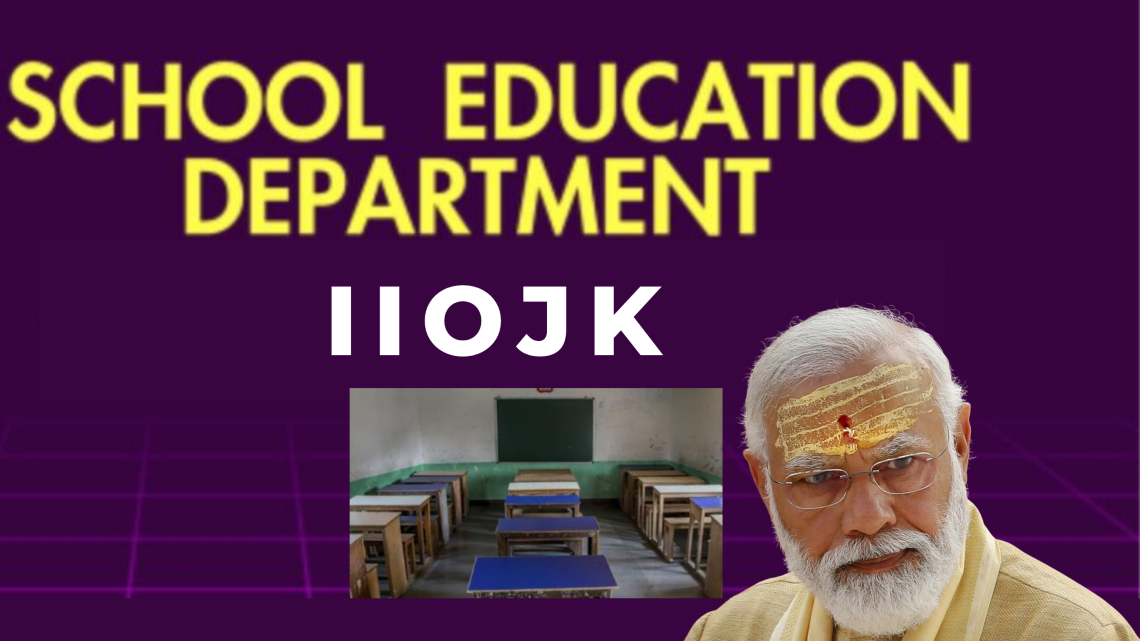
Over 2,000 Key Education Posts Vacant in IIOJK, Raising Concerns Over Hindutva-Driven Delay
July 1, 2025In Indian illegally occupied Jammu and Kashmir, a severe shortage of educators is crippling the school system—fueling suspicions that the prolonged vacancies are part of a calculated effort to push ideological appointments under Modi’s Hindutva agenda.
The education sector in Indian illegally occupied Jammu and Kashmir (IIOJK) is facing a deepening crisis, with over 2,000 key teaching and administrative positions lying vacant in government-run schools across the territory. The prolonged delay in recruitment is not only disrupting academics but also raising questions about the intentions behind the inaction.
According to official data, more than 1,600 posts of lecturers and 480 posts of headmasters are currently vacant in schools under the School Education Department. The absence of qualified staff is having a serious impact on the functioning of schools, affecting both teaching quality and the management of daily academic affairs.
Education experts and political observers say the continued failure to fill these critical roles appears far from accidental. Many believe the delay is a deliberate move by the Modi-led regime to create space for ideological appointments aligned with its broader Hindutva agenda.
“The vacancies are not just administrative oversights,” said an education analyst in Srinagar. “They reflect a strategic pause that may eventually lead to the selection of individuals who subscribe to a specific ideological outlook, rather than purely professional merit.”
This suspicion is further reinforced by the larger pattern of centralization and control seen in IIOJK after the revocation of its special status in 2019. Since then, the education system—like other institutions—has come under tighter scrutiny and intervention from New Delhi, often at the cost of local autonomy and transparency.
The vacant positions are just one part of a larger problem. Government-run schools in the region also suffer from a chronic lack of infrastructure and basic facilities. Many schools do not have functional playgrounds, libraries, or computer labs. Internet access remains patchy, and in some rural areas, it is entirely absent.
Despite repeated appeals from school administrators, parents, and local officials, the government has failed to prioritize investment in educational infrastructure. Students are often forced to learn in overcrowded classrooms, with outdated materials and insufficient teaching support.
Teachers who remain on duty are overstretched, often handling multiple classes and subjects without proper training or assistance. In some schools, temporary staff or untrained substitutes are used to fill gaps, which further compromises the quality of education.
Parents and community members have expressed frustration over the government’s apathy. Many feel that the neglect of the education sector is contributing to a wider pattern of marginalization and systemic weakening of institutions in IIOJK.
“This is not just about unfilled jobs—it’s about an entire generation being deprived of quality education,” said a school principal from South Kashmir. “The longer these posts remain vacant, the deeper the damage.”
Civil society groups and teacher associations are calling for urgent action to address the issue. They are demanding a transparent and merit-based recruitment process, improved facilities, and policy reforms that reflect the educational needs of the region rather than political calculations.
As the situation worsens, the growing gap between the government’s development rhetoric and ground realities becomes more evident. For the youth of IIOJK, access to quality education remains a distant promise—caught between bureaucratic inertia and ideological agendas.